








Artificial intelligence is rapidly transforming the communications industry. What began as a tool for automation has now evolved into a strategic force shaping how brands build trust, manage reputation, and engage audiences. As organisations move deeper into an AI-first world, AI-Led communication functions are being redefined at both operational and strategic levels.
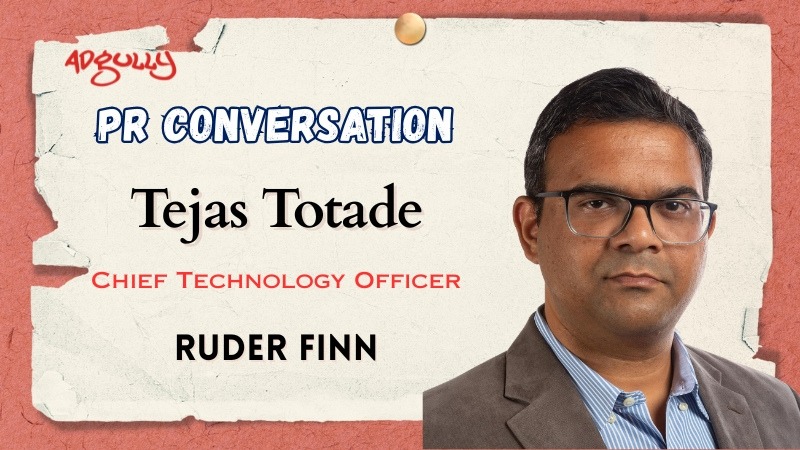
In conversation with Adgully, Tejas Totade, Chief Technology Officer at Ruder Finn, shares his global perspective on how AI is changing the very foundation of communications. According to him, the future will not be driven by technology alone. Instead, transparency, ethical deployment, and strong human judgement will determine how successfully AI is integrated into brand communication strategies.
AI’s Shift From Tool to Strategic Partner
For many years, AI played a largely supportive role in communications. It helped automate repetitive tasks, improve efficiency, and assist with data processing. However, Totade believes this role is expanding quickly. AI is no longer limited to execution. It is increasingly becoming an integrator that connects insights, workflows, creativity, and decision-making across the organisation.
This shift is largely driven by the ability to embed AI directly into everyday workflows. When AI becomes part of how teams research, plan, monitor, and respond, it moves from being an external tool to an internal collaborator. This allows communication professionals to operate with greater speed and intelligence, while still retaining strategic control.
Embedding AI Into Everyday Workflows
Totade explains that the real opportunity lies not in occasional AI usage, but in deep workflow integration. When AI is seamlessly built into daily operations, it reduces friction and enables teams to focus on interpretation rather than information gathering.
However, he also cautions that this transformation cannot happen by simply adding new tools. Organisations must rethink how work is structured. Without redesigning workflows, AI risks becoming underutilised or misaligned with real business needs. True value emerges only when technology and human processes evolve together.
AI-Led Search Is Changing Reputation Dynamics
One of the most significant shifts Totade highlights is the rise of AI-led search and discovery. As audiences increasingly rely on AI-generated answers instead of traditional search engines, the way reputations are formed is changing fundamentally.
Earlier, visibility was about ranking high on search results. Today, it is about how AI systems interpret, summarise, and contextualise information. If data sources are incomplete or inconsistent, AI can unintentionally distort brand narratives. This introduces new reputational risks that communication teams must actively manage.
As a result, reputation management now requires ensuring that accurate, credible, and structured information feeds into AI ecosystems.
Trust, Transparency, and Risk Management
With AI playing a growing role in information delivery, trust becomes the central issue. Totade emphasises that while AI can amplify efficiency and insight, it can also amplify errors at scale. This makes transparency critical.
Audiences want to know how information is created, where AI is involved, and how decisions are made. In communications, credibility depends not only on messaging but also on openness. Totade believes organisations must be clear about AI usage while maintaining strong human oversight to safeguard accuracy and ethics.
India’s Growing Influence in AI Innovation
Totade also points to India’s increasing importance in the global AI landscape. The country has moved beyond being a delivery centre and is emerging as a strategic innovation hub.
With strong engineering talent and exposure to diverse global markets, Indian teams are helping shape AI systems that are both scalable and culturally aware. This positions India as a key contributor to the future of AI-led communications, especially as global agencies invest more deeply in local innovation capabilities.
The Irreplaceable Role of Human Judgement
Despite rapid technological progress, Totade is clear that AI cannot replace human judgement. Communications relies heavily on emotion, cultural sensitivity, and ethical reasoning — areas where machines still fall short.
AI can analyse data, identify patterns, and suggest options. However, humans must make the final decisions, particularly during crises, sensitive situations, or moments requiring empathy. Accountability, he stresses, will always remain human, regardless of how advanced AI becomes.
Ethical AI as a Foundation for Credibility
As adoption increases, ethical AI use will become a defining factor for brand credibility. Totade believes organisations must establish clear governance frameworks that guide how AI is deployed, how data is sourced, and how bias is addressed.
Without ethical guardrails, AI risks weakening trust rather than strengthening it. In the future, communication leaders will need to combine storytelling expertise with a strong understanding of AI systems and their implications.
A Collaborative Future for Communications
Looking ahead, Totade envisions a collaborative model where AI and humans work together. AI will provide speed, scale, and analytical depth, while humans will lead strategy, creativity, and moral judgement.
This partnership will allow communication teams to respond faster, think smarter, and operate with greater confidence. AI, in this sense, does not replace communicators — it enhances their ability to deliver meaningful impact.
Building Future-Ready Communication Strategies
As AI continues to reshape the industry, the path forward is clear. Technology alone cannot build trust. Transparency, ethical intent, and strong human judgement must guide every deployment.
AI may power communication systems, but people will define their purpose. In an increasingly automated world, authenticity will remain human.