









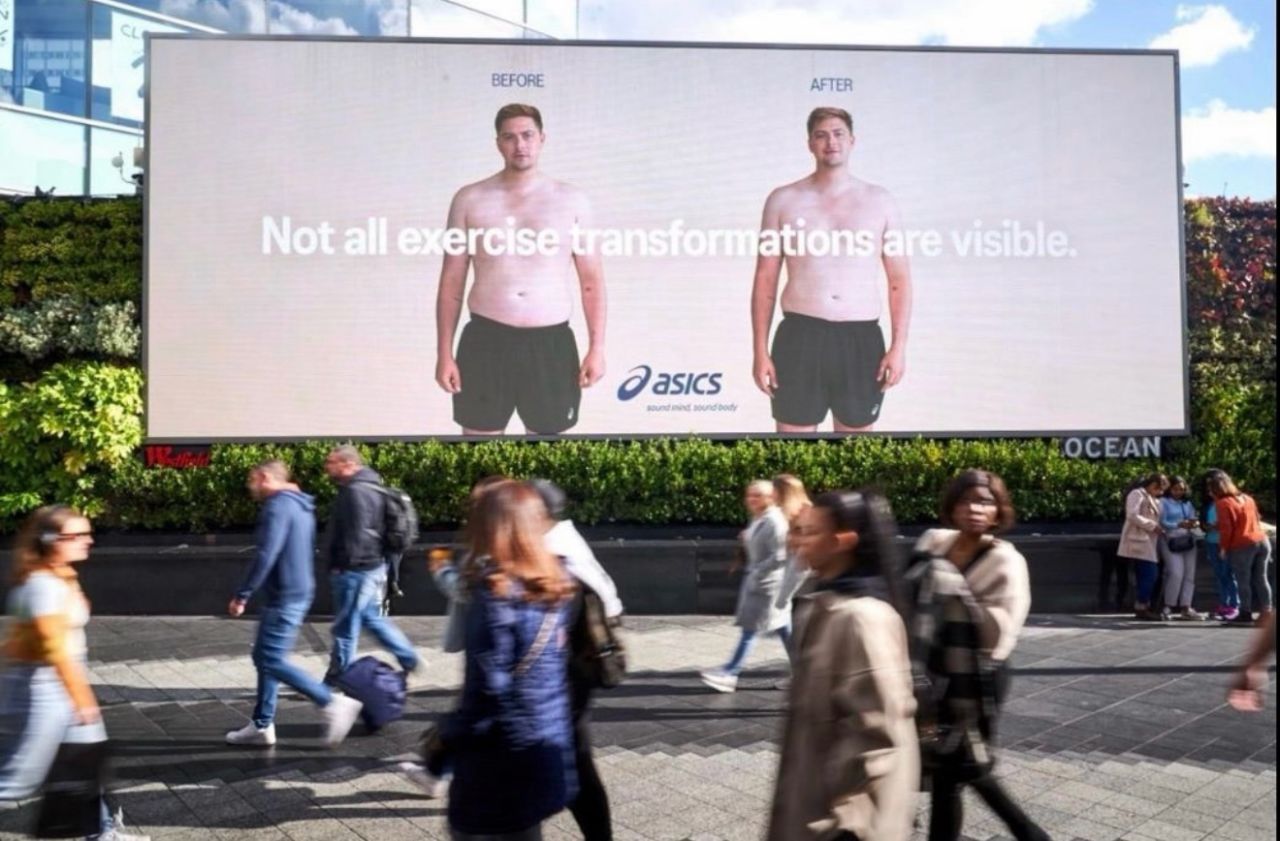
In an era defined by “hustle culture” and the constant digital noise of the 2020s, the most radical thing a brand can do is ask you to slow down. ASICS, the Japanese sportswear giant, did exactly that with its “Move Your Body, Move Your Mind” global campaign.
By stripping away the aggressive “win-at-all-costs” imagery typical of the industry, ASICS and creative agency AGIT8 created an Outdoor Advertising (OOH) campaign that didn’t just sell shoes it sold a state of mind.
1. The “Less is More” Visual Architecture
The campaign’s impact lies in its extreme minimalism. In high-traffic urban centers like Tokyo’s Shibuya Crossing or London’s Waterloo, ASICS deployed billboards that were remarkably “quiet.”
-
The Focal Point: Instead of complex graphics, the ads featured moments of personal serenity a runner lost in thought, a tennis player in a moment of calm focus set against the vibrant yet soft-focus backdrop of Tokyo at “magic hour.”
-
The Negative Space: By utilizing vast amounts of clean, open space, the brand forced the viewer’s eye to rest on the human element. In 2026, where every other digital screen is fighting for attention with flashing colors, this “visual silence” became the loudest thing on the street.
2. Flipping the Narrative: Soft Performance
For decades, sports brands like Nike and Adidas built their OOH legacy on “Performance.” They showed sweat, grit, and the breaking of records. ASICS pivoted to “Soft Performance.”
The campaign message “You don’t need a trophy to feel like you’re winning. All you need to do is move” struck a chord with a post-pandemic generation more concerned with anxiety management than marathon times. This human-centric approach transformed the billboard from a product catalog into a mental health reminder. It wasn’t about being the best athlete; it was about being a better-feeling human.
3. The Science of the “15-Minute Reset”
What made the campaign truly effective was its grounding in accessible science. ASICS leveraged research showing that just 15 minutes and 9 seconds of exercise can significantly lift a person’s mental state.
By putting this “15-minute” threshold on their OOH assets, they lowered the barrier to entry. The ad didn’t demand an hour at the gym; it suggested a quick walk or a light jog. This made the brand feel like an ally rather than a coach, driving massive ROI through brand affinity and “Love-mark” status.
4. The Global “Sound Mind” Identity
The campaign successfully brought the brand’s acronym to life: Anima Sana In Corpore Sano (A Sound Mind in a Sound Body). By integrating the iconic track “Good Vibrations” by The Beach Boys into the digital versions of these ads (DOOH), ASICS created a multi-sensory experience that felt “light” and “joyful.”
In India, the campaign took a localized turn by onboarding cricketers like Shivam Dube and Varun Chakravarthy. Even here, the OOH didn’t focus on their explosive power on the field, but on their “tactical clarity” and “composure” further reinforcing that the mind is the ultimate athlete.
Conclusion: Simplicity as a Superpower
The ASICS campaign proves that simplicity always wins. By trusting a single, powerful image and a universal human truth, the brand bypassed the “Ad Blindness” that plagues modern consumers. They didn’t just show a shoe; they showed the peace of mind that shoe could help you find.
In the marketing landscape of 2026, ASICS has set the gold standard: To move the market, you must first move the mind.