





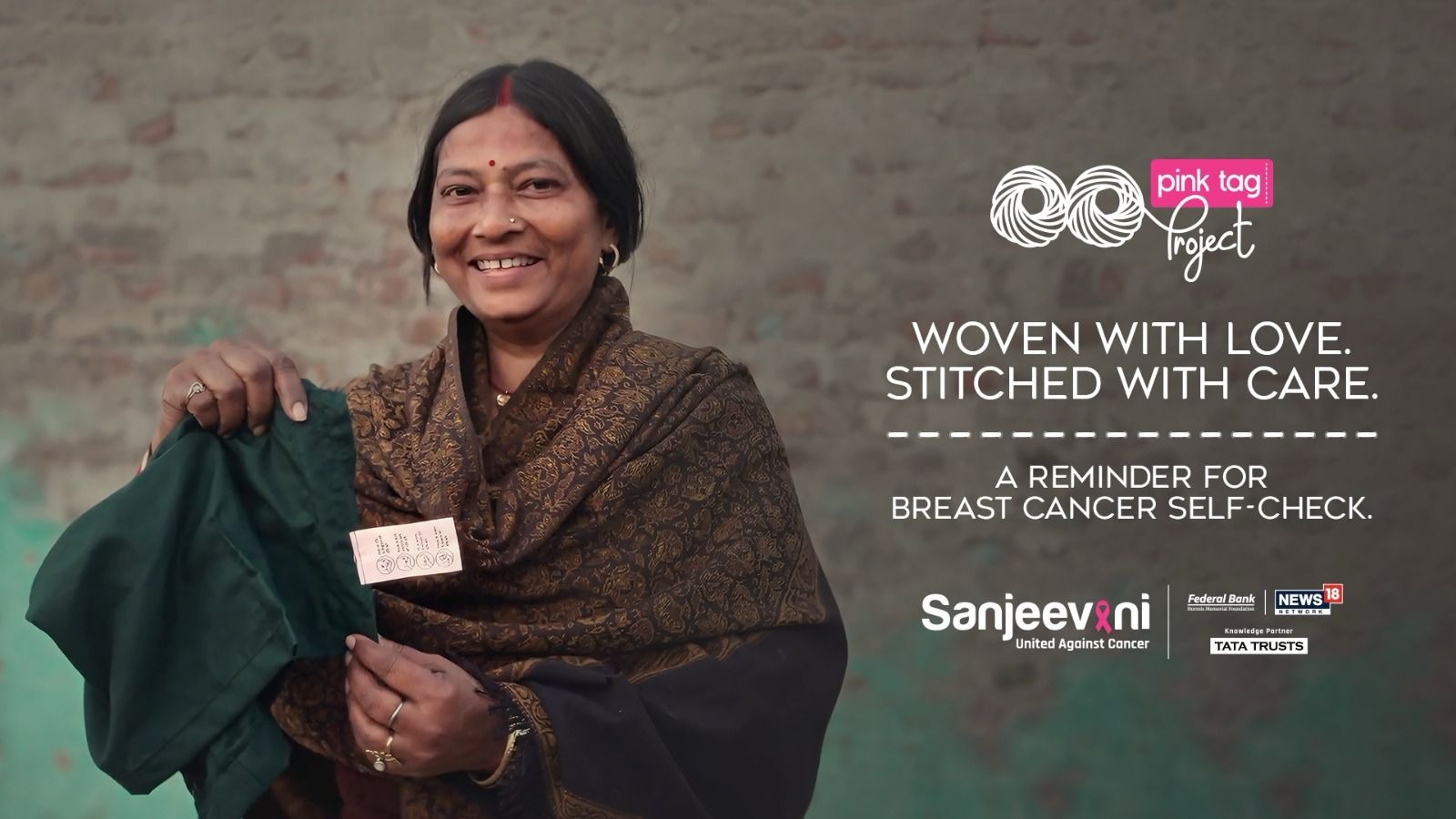
Breast cancer remains one of the most pressing health challenges for women in India. Despite medical progress, late detection continues to claim lives due to lack of awareness, social hesitation, and limited access to timely information.
Addressing this critical gap, the Sanjeevani Pink Tag Project campaign introduces a quiet yet powerful behavioural intervention. Launched under the third edition of Sanjeevani: United Against Cancer, the initiative is driven by the Federal Bank Hormis Memorial Foundation in association with the News18 Network and knowledge partner Tata Trusts.
Rather than relying on public messaging alone, the project embeds awareness directly into a woman’s daily routine.
Understanding the Urgency Behind Breast Cancer Awareness
The statistics present a sobering reality. In India, a woman is diagnosed with breast cancer every four minutes. Even more alarming, one woman loses her life to the disease every eight minutes.
In many small towns and rural communities, conversations around breast health remain limited. Social stigma, lack of medical access, and prioritisation of family responsibilities often push personal health concerns aside.
The Sanjeevani Pink Tag Project campaign responds to this silence with empathy rather than alarm.
The Insight That Shaped the Sanjeevani Pink Tag Project Campaign
At the heart of the initiative lies a simple yet powerful observation. For many women, the moment of getting dressed is one of the rare times they are alone, unhurried, and focused on themselves.
Instead of asking women to attend workshops or remember dates, the campaign integrates awareness into this private moment.
By using clothing — something worn daily — the message becomes consistent, personal, and non-intrusive.
How the Pink Tag Creates a Private Health Reminder
The project places a small pink tag inside everyday garments such as:
-
Blouses
-
Kurtas
-
Innerwear
Positioned beside the wash-care label, the tag carries clear instructions for breast self-examination.
Because women encounter these tags repeatedly, the information reinforces itself naturally over time. Importantly, it does not require appointments, external prompts, or public participation.
This design makes the Sanjeevani Pink Tag Project campaign both discreet and deeply effective.
Behavioural Change Through Repetition, Not Fear
Many health campaigns rely on fear-driven messaging. However, fear often leads to avoidance rather than action.
In contrast, the Sanjeevani Pink Tag Project campaign uses repetition and familiarity. Each glance at the tag becomes a gentle nudge, not a warning.
This approach builds awareness gradually, encouraging early self-check habits without anxiety or pressure.
Reaching Women Beyond Urban Awareness Campaigns
Urban audiences often have better access to healthcare information. However, semi-urban and rural women remain underserved.
By embedding the message into garments, the campaign travels naturally across geographies, income levels, and age groups. Clothing does not discriminate, and neither does the message stitched within it.
As a result, the initiative ensures reach far beyond digital or media-led interventions.
Role of Sanjeevani United Against Cancer Initiative
The Pink Tag Project forms part of the broader Sanjeevani: United Against Cancer platform, which aims to drive long-term cancer awareness through education and collaboration.
With support from trusted institutions such as Tata Trusts and News18 Network, the awareness campaign gains both credibility and scale.
The Sanjeevani Pink Tag Project campaign thereby transforms awareness into a sustained movement rather than a one-time communication.
Why the Pink Tag Project Represents Purpose-Driven Communication
This campaign demonstrates how meaningful impact often lies in simplicity. Instead of complex technology or high-cost installations, it uses a small tag to deliver life-saving knowledge.
Its strength lies in:
-
Cultural sensitivity
-
Privacy-first design
-
Daily habit integration
-
Long-term recall
Therefore, the campaign sets a strong benchmark for purpose-led communication in India.
Everyday Clothing as a Medium for Public Health Messaging
Traditionally, clothing labels communicate fabric and wash instructions. By adding health guidance alongside these details, the campaign redefines the role of everyday objects.
The Sanjeevani Pink Tag Project campaign proves that powerful communication does not always require screens or billboards. Sometimes, the most effective medium is already part of daily life.
Conclusion: Small Stitch, Life-Saving Impact
The Sanjeevani Pink Tag Project campaign shows how awareness can be built quietly yet meaningfully. By turning a private daily moment into an opportunity for self-care, the initiative empowers women without disruption or discomfort.
In a country where early detection can save thousands of lives, this small pink tag carries immense significance.
Ultimately, the campaign reminds us that sometimes, the simplest ideas — stitched into everyday life — can create the greatest impact.