




For decades, the Out-of-Home (OOH) industry was the “analog giant” of the advertising world. You bought a board, you put up a poster, and you prayed that the right people drove past it. It was about scale, but it lacked the one thing that made digital advertising king: Precision.
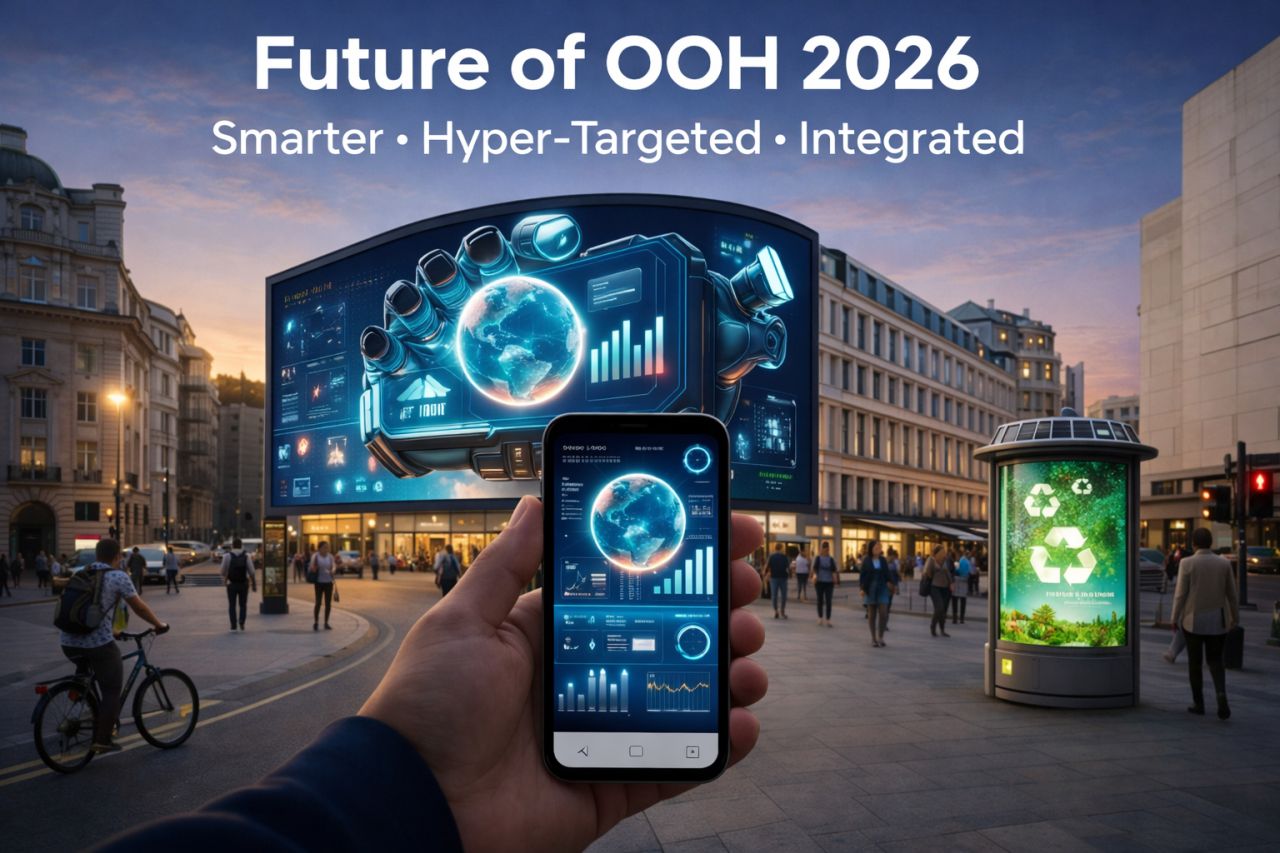
Welcome to 2026. The “analog giant” has woken up, and it’s now the most sophisticated data-driven engine in the marketing mix. Today, OOH isn’t just about being “big” it’s about being “right.” Through the integration of AI, programmatic buying, and immersive technology, the skyline has become a living, breathing digital ecosystem.
As we scale these innovations through platforms like Edge1 at US Technosoft, we are seeing a fundamental shift in how brands interact with the physical world. Here is why OOH is dominating the 2026 landscape and exactly where the “Smart City” is headed next.
1. Programmatic OOH 2.0: The End of “Static” Budgets
The biggest transformation in 2026 is the maturity of Programmatic OOH (pDOOH) 2.0. In the past, buying a billboard was a manual, weeks-long process. Today, it happens in milliseconds.
AI-driven buying platforms now enable real-time optimization. If a retail brand sees a sudden dip in foot traffic at a specific mall location, the system can automatically bid on and trigger ads on every digital screen within a two-mile radius. This isn’t just “buying an ad”; it’s reactive problem-solving. We are moving away from fixed “loops” and moving toward “trigger-based” exposure. If it rains, the shoe brand switches to boots. If the local sports team wins, the victory merchandise appears instantly.
2. Hyper-Personalization: The “Mobile-to-Street” Bridge
In 2026, the wall between your smartphone and the street has collapsed. By integrating anonymized mobile location data with behavioral analytics, brands are now delivering ultra-relevant messages at the exact moment of intent.
We aren’t talking about “Minority Report” style creepy callouts. We are talking about Contextual Relevance. When a group of “fitness-conscious” commuters exits a transit hub, the nearby digital screens don’t show generic soda ads; they show protein recovery drinks or local gym trials. This hyper-targeting ensures that OOH is no longer “wasted” on the wrong eyes. It brings the surgical precision of Facebook or Google Ads into the physical world, making every impression count toward a measurable ROI.
3. The “Phygital” Revolution: Closing the Loop
The term “Phygital” the blending of Physical and Digitalnhas moved from a buzzword to a standard operating procedure. Immersive OOH is the new frontier of engagement.
In 2026, a 3D digital billboard isn’t just a spectacle; it’s a portal. Shoppers are now using AR (Augmented Reality) on their phones to “pull” products off a 3D screen and see how they look on their own wrists or in their own living rooms. This creates a seamless bridge between a high-impact street visual and a digital shopping cart. At US Technosoft, we see this integration as the “Holy Grail” of marketing: combining the massive reach of a billboard with the instant conversion of an e-commerce link.
4. Sustainability: The New License to Operate
In 2026, being “loud” isn’t enough; you have to be “clean.” The OOH industry has faced scrutiny over energy consumption, and the response has been a total pivot toward Sustainable and Smart Media.
We are now seeing the rise of:
-
Energy-Efficient Display Technology: Screens that adjust brightness based on ambient light to save power.
-
Carbon Tracking: Brands are now demanding to see the carbon footprint of their outdoor campaigns.
-
Eco-Conscious Formats: From smog-eating vinyl posters to solar-powered bus shelters.
Sustainability is no longer a “PR stunt.” It is a core requirement for any brand looking to advertise in a modern, climate-conscious city. In 2026, the medium is just as much a part of the message as the creative itself.
5. From “Reach” to “Real Impact”
The final, and perhaps most important, shift is Measurability. For the first time, OOH management software like Edge1 is allowing companies to track the “Last Mile” of the consumer journey.
We can now prove that a person saw a digital screen, walked into a store 15 minutes later, and made a purchase. This data loop has turned OOH from a “brand awareness” tool into a “performance marketing” powerhouse. Brands are no longer asking “How many people saw this?” but rather “How many people did this drive to my store?”
Conclusion
The Out-of-Home industry in 2026 is a far cry from the paper-and-paste billboards of the past. It is a high-tech, high-stakes environment where precision, creativity, and measurable impact are the new currencies of success.
As we continue to push the boundaries of what is possible with Edge1 Outdoor Media Management, it is clear that OOH is no longer just a “support” channel. It is the backbone of the modern, connected city. Whether through 3D immersion, AI-driven bidding, or sustainable innovation, the future of advertising is happening right now, out in the world, where life actually happens.