



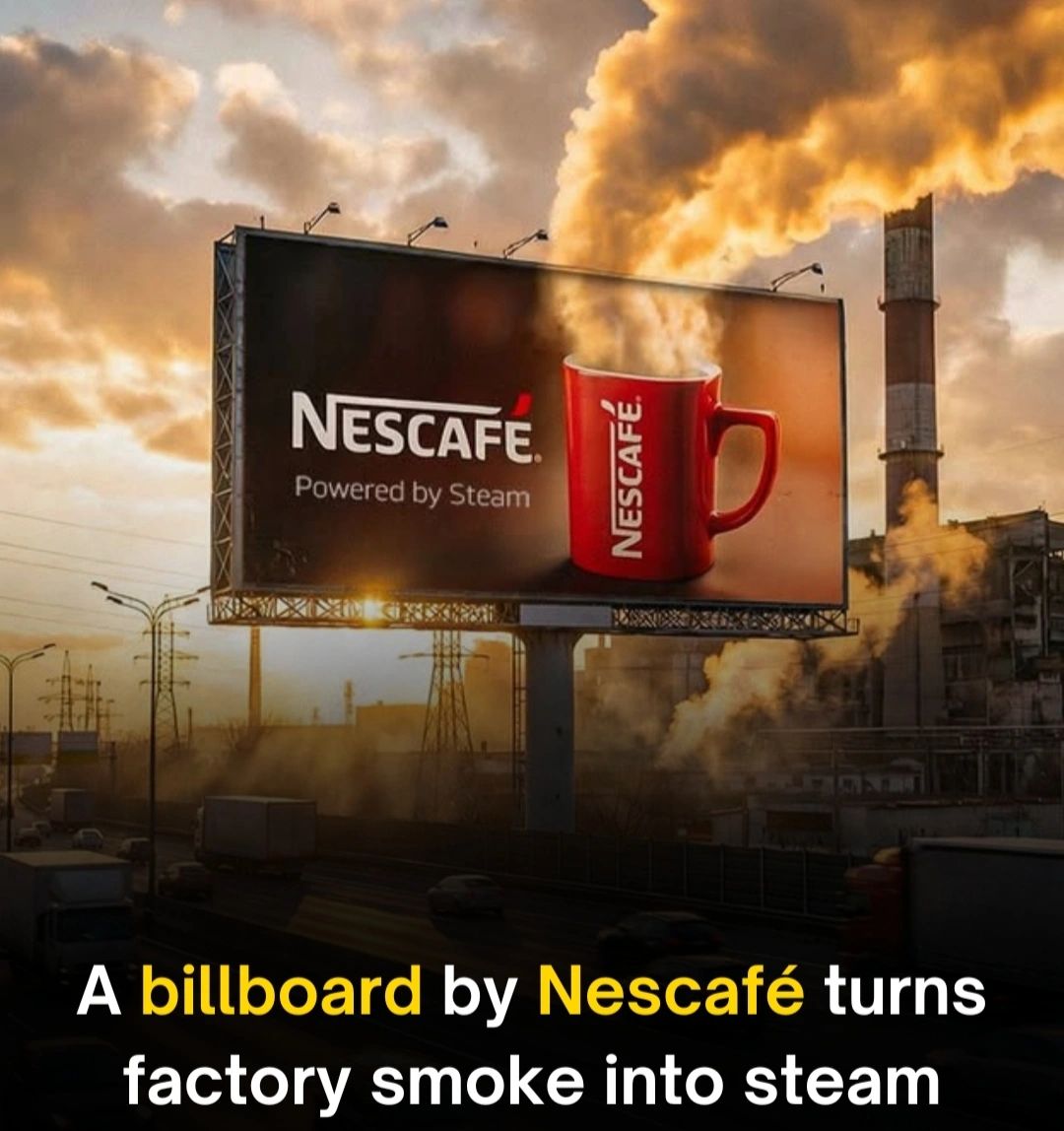
In an era of million-dollar CGI budgets and flashy 3D digital screens, a student-led concept for Nescafé has reminded the global marketing community of a simple truth: Observation is the ultimate creative tool. The campaign, titled “Powered by Steam,” was developed by Ziad Waleed, a creative student from Helwan University. It doesn’t rely on expensive tech or heavy production. Instead, it relies on one thing: The Perfect Sightline.
1. The Power of “Environmental Borrowing”
The concept is deceptively simple. A minimalist billboard featuring the iconic Nescafé red mug is placed in direct visual alignment with a factory chimney. To a driver or pedestrian at the correct angle, the industrial smoke from the chimney appears as the rising, aromatic steam of a fresh cup of coffee.
This is what marketers call Ambient OOH. Instead of fighting against a “harsh” or “ugly” industrial landscape, the brand integrates into it. It transforms a grey environmental eyesore into a warm, relatable brand moment.
2. Contextual Marketing vs. Traditional Advertising
Most outdoor ads scream for attention. This one rewards it. Here is why it works:
-
The “Aha!” Moment: Because the “steam” is real and moving, it creates a visual puzzle that the human brain loves to solve. When the viewer makes the connection, the brand recall is significantly higher than a standard static image.
-
Low Cost, High Impact: There are no moving parts, no electricity costs for high-res LEDs, and no complex maintenance. The “special effect” is provided for free by the city’s infrastructure.
-
Shareability: In 2026, the success of OOH is measured by its “social ripple.” This execution is inherently “Instagrammable” because it frames the real world in a way that feels like a discovery.
3. Turning “Pollution” Into “Perspective”
One of the most daring aspects of Ziad Waleed’s concept is the subversion of industrial imagery. Factories are often associated with work, stress, and environmental impact. By reframing that smoke as “steam,” Nescafé positions itself as the “fresh start” or the “break” in the middle of a tough, industrial day. It softens the environment through the lens of the brand.
4. The Lesson for Modern Brands
This Nescafé concept is a masterclass in Visual Storytelling. It proves that:
-
Placement is Content: The media buy is the creative. Without the chimney, the billboard is just a picture of a cup. With it, it’s an experience.
-
Budget ≠ Brilliance: You don’t need a Super Bowl budget to go viral. You need a sharper eye for how people actually navigate their physical surroundings.
-
Simplicity Scales: The ad has zero copy (text). It doesn’t need to be translated. It is a universal visual language that works in Mexico City, Cairo, or Abu Dhabi.
Conclusion
Ziad Waleed’s Nescafé concept is a “genius” intersection of guerrilla marketing and design thinking. It serves as a wake-up call to advertisers who have become overly reliant on digital tools. Sometimes, the most powerful thing a brand can do is look out the window, find something “ugly,” and figure out how a cup of coffee can make it look beautiful.