
India’s digital revolution has redefined how brands connect with consumers. The rapid rise of e-commerce, social media, and mobile-first behavior has blurred the lines between traditional FMCG giants and emerging D2C challengers.
However, while both sectors aim for visibility and loyalty, their approaches to digital branding and customer acquisition differ dramatically. FMCG brands depend on heritage, scale, and mass communication. D2C brands, on the other hand, thrive on agility, personalization, and data-driven engagement.
Let’s explore how these two models are rewriting India’s brand-building playbook in the age of digital commerce.
Understanding the Two Models
1. FMCG (Fast-Moving Consumer Goods)
FMCG brands like HUL, Nestlé, ITC, and P&G operate in highly competitive categories where shelf visibility and distribution dominate. Their primary goal is to ensure widespread availability across retail, e-commerce, and rural markets.
Historically, FMCG success relied on mass media branding — TV, print, and outdoor ads. But with consumers shifting online, these legacy brands are adopting digital-first storytelling and performance-driven marketing to maintain their leadership.
2. D2C (Direct-to-Consumer)
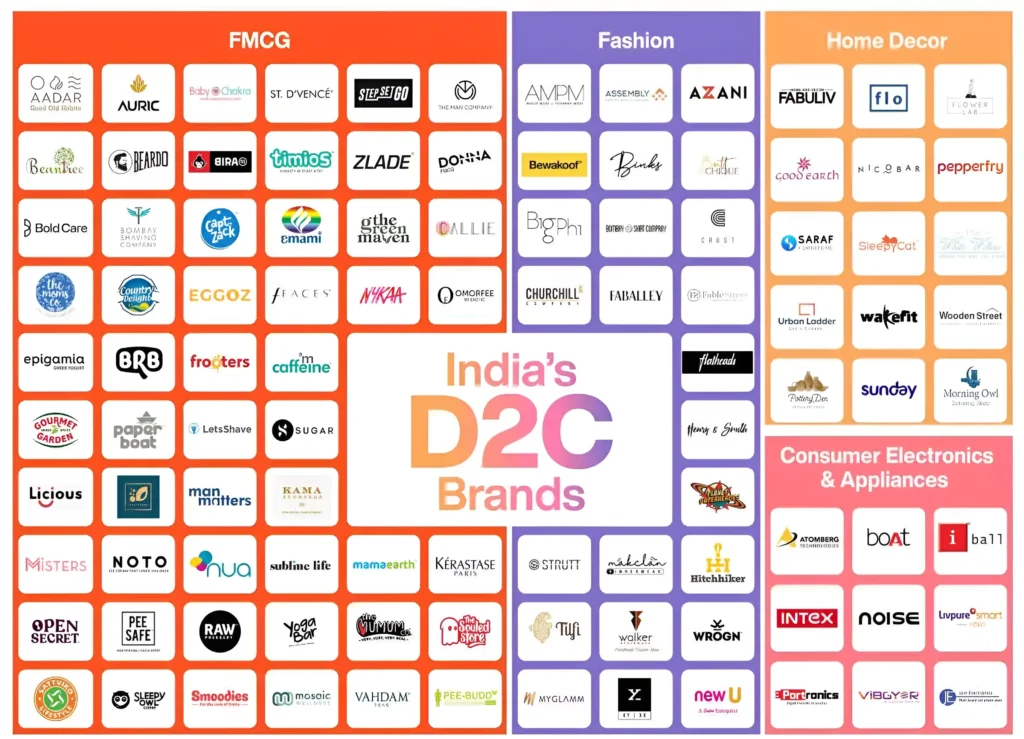
D2C brands such as Mamaearth, Boat, Sugar Cosmetics, and Wakefit sell directly to customers via their own websites and digital marketplaces.
Unlike FMCG companies, D2C brands bypass intermediaries, owning both the relationship and data. This gives them a deep understanding of consumer behavior and the flexibility to launch niche, purpose-driven products.
They rely heavily on digital media, influencer collaborations, and CRM automation to scale efficiently and build emotional loyalty.
Different DNA, Same Goal: Building Brand Love
Both FMCG and D2C brands ultimately chase brand trust and customer loyalty, but their paths differ.
FMCG focuses on reach and consistency, while D2C emphasizes experience and community. Let’s break down their digital branding and customer acquisition strategies.
1. Digital Branding: Mass Appeal vs. Micro Connection
FMCG: Building Trust Through Legacy
FMCG brands are storytellers at scale. Their branding relies on universal emotions — family, trust, and everyday reliability.
Campaigns like “Daag Ache Hain” (Surf Excel) or “Har Ghar Amul Ghar” demonstrate how legacy brands sustain emotional resonance across generations.
Digitally, they’ve adapted by using:
-
High-impact video ads across YouTube, OTT, and connected TV.
-
Regional language campaigns to expand into Bharat markets.
-
Influencer collaborations with macro-creators to modernize perception.
They leverage their massive budgets to maintain top-of-mind recall — blending nostalgia with contemporary digital narratives.
D2C: Building Identity Through Purpose
D2C brands take a more authentic, storytelling-first approach. Their brand identity often revolves around purpose, sustainability, and individuality.
For example:
-
Mamaearth built credibility by positioning itself as a toxin-free, eco-conscious brand.
-
Boat appeals to youth energy through music, sports, and fashion tie-ups.
Digital branding for D2C brands relies on:
-
Social-first content (Reels, UGC, and influencer shoutouts).
-
Community engagement via reviews, live sessions, and loyalty groups.
-
Content marketing that educates and inspires instead of just selling.
Their strength lies in humanized storytelling — showing real people, real experiences, and relatable brand journeys.
2. Customer Acquisition: Mass Awareness vs. Data Precision
FMCG: Scale-Driven Acquisition
For FMCG brands, customer acquisition is a volume game. Their marketing funnels are broad, relying on traditional awareness tools complemented by digital amplification.
Key tactics include:
-
Programmatic and display advertising to boost reach.
-
Sampling campaigns through e-commerce and offline activations.
-
Collaborations with marketplaces like BigBasket and Blinkit for visibility.
-
Television + Digital integration for full-funnel impact.
Their strength lies in omnichannel dominance — ensuring every consumer, whether in a metro or Tier-III town, sees their product.
However, what FMCG brands gain in reach, they often lose in data ownership, as intermediaries handle transactions.
D2C: Precision Marketing Through Data
For D2C brands, acquisition is data-led and performance-driven. Every click, scroll, and purchase fuels insight.
They use first-party data, retargeting, and AI-driven personalization to acquire and retain users efficiently.
Common acquisition tactics include:
-
Social media ads (Instagram, Meta, Google).
-
Influencer collaborations to drive awareness and trust.
-
Email and WhatsApp marketing automation for retention.
-
Affiliate marketing and referral programs.
D2C brands excel at testing and iterating quickly — shifting budgets in real time based on performance metrics like CAC (Customer Acquisition Cost) and LTV (Lifetime Value).
3. Channel Strategy: Distribution vs. Direct Engagement
FMCG: Omnipresence Is Power
FMCG brands dominate through a multi-layered distribution model — general trade, modern retail, and e-commerce.
Their strategy is simple: be everywhere the consumer looks.
Digital efforts now include:
-
D2C sub-brands (e.g., HUL’s “Simple Skincare” or Nestlé’s “Tasty Recipes”).
-
Online brand stores for premium product lines.
-
E-commerce collaborations to own high-intent search moments.
However, FMCG remains largely dependent on third-party retailers, which limits personalization and direct data flow.
D2C: Building Direct and Loyal Relationships
D2C brands bypass traditional retail entirely. Their websites are their primary stores, giving them control over pricing, storytelling, and customer data.
Additionally, they use marketplaces like Amazon and Nykaa as discovery platforms but focus on retention through owned channels.
Their customer experience is built on:
-
Fast response times via chatbots or WhatsApp.
-
Personalized recommendations based on browsing history.
-
Community engagement through loyalty programs and newsletters.
This direct model drives brand intimacy — turning buyers into advocates.
4. Marketing Technology and Automation
FMCG: Scaling with Martech Ecosystems
FMCG brands integrate enterprise-level Martech stacks to manage campaigns across millions of customers.
Their tools include:
-
CRM suites like Salesforce or Adobe Experience Cloud.
-
Automated media buying through DSPs and AI analytics.
-
Consumer data platforms (CDPs) for unified insights.
While automation enhances efficiency, the process is slower due to organizational layers and global governance structures.
D2C: Agility Through Automation
D2C brands thrive on lightweight, agile Martech tools.
They adopt marketing automation platforms like MoEngage, CleverTap, or HubSpot for:
-
Personalized notifications.
-
Automated WhatsApp and email journeys.
-
Behavioral segmentation.
This nimble setup allows them to react faster to trends, adjust pricing dynamically, and run flash campaigns in minutes.
5. Customer Retention and Loyalty
FMCG: Emotional Loyalty
FMCG loyalty is built on habit and heritage. Consumers trust what’s familiar.
Brands maintain this loyalty through consistent quality, emotional storytelling, and CSR initiatives.
Example: Lifebuoy’s hygiene campaigns and Dove’s Real Beauty movement reinforce long-term emotional value rather than transaction-based loyalty.
D2C: Experiential Loyalty
D2C brands focus on experience-driven retention.
They personalize journeys using customer data, rewarding loyalty through exclusive drops, early access, and personalized packaging.
The direct communication loop helps them collect feedback instantly — turning customers into co-creators rather than passive buyers.
6. Advertising Philosophy: Push vs. Pull
-
FMCG brands push their message to the masses — often through TVCs, large-scale OOH, and digital branding.
-
D2C brands pull consumers in with authenticity — leveraging storytelling, influencer relatability, and organic communities.
Both models complement each other: FMCG offers scale; D2C delivers depth.
The Convergence: FMCG Learns D2C, D2C Scales Like FMCG
The gap between FMCG and D2C is narrowing fast.
FMCG giants are acquiring or investing in D2C startups to inject agility and data-driven innovation. Meanwhile, D2C brands are partnering with offline retailers to expand reach.
This hybrid future will see coexistence, not competition, where heritage brands adopt personalization, and digital-first brands embrace scale.
Conclusion
The FMCG vs. D2C debate isn’t about which is better — it’s about how each adapts to changing consumer behavior.
FMCG brands bring decades of trust and scale. D2C brands bring agility, transparency, and innovation. Together, they represent the new spectrum of digital brand evolution in India.
In 2025 and beyond, successful brands won’t belong to one model — they’ll blend both worlds, combining FMCG consistency with D2C intimacy to win the digital consumer’s heart and wallet.